Google officially released Gemini 3.6 Flash on July 21, 2026. It is not an all-purpose model intended to replace every frontier system. It is a production workhorse designed to combine Flash-level speed and cost with stronger coding, knowledge work, multimodal understanding, long context, and Agent execution.
The headline claim is that it uses 17% fewer output tokens than Gemini 3.5 Flash. That number alone does not answer whether you should adopt it. Developers need to know its API price, context limits, benchmark gains, position against current models, and whether early users agree with Google’s efficiency story.
This guide combines Google’s model documentation, the Google DeepMind benchmark table, Artificial Analysis measurements, and early community discussion. Information was checked on July 22, 2026. The model had been available for only one day, so rankings, prices, and community sentiment may still change quickly.
Bottom line: Gemini 3.6 Flash does not beat GPT-5.6, Claude Sonnet 5, or Grok 4.5 on every capability. Its value is the combination of very high output speed, a 1M-token context window, and competitive coding, Computer Use, and chart-understanding performance. It is a strong candidate for real-time Agents, frontend iteration, long-document analysis, and multimodal workflows, but production teams should still test it on their own acceptance set.
Key Takeaways
- Production status:
gemini-3.6-flashis generally available rather than a preview model. - Large context: it accepts up to 1,048,576 input tokens and produces up to 65,536 output tokens. Inputs can include text, images, video, audio, and PDFs; output is text.
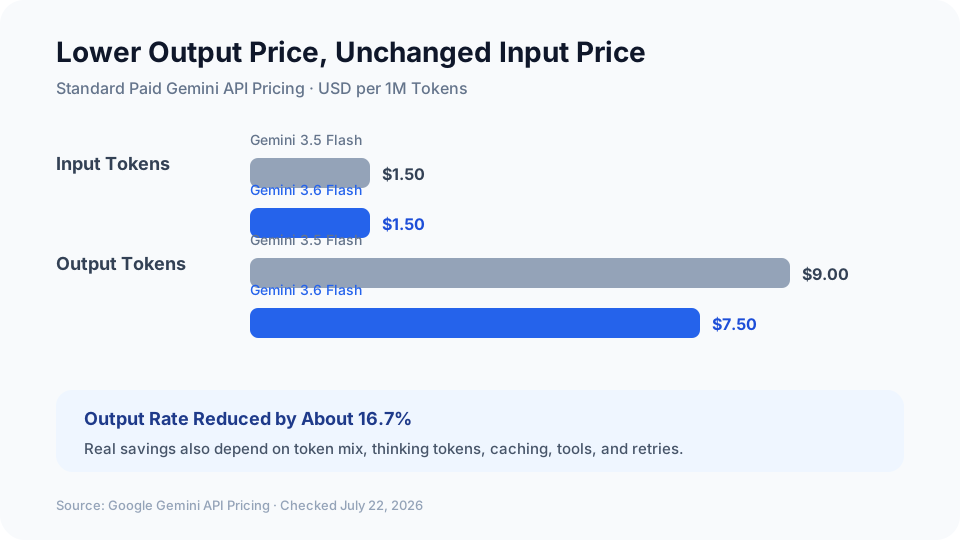
- Better pricing than its predecessor: input remains $1.50 per million tokens, while output falls from $9.00 for Gemini 3.5 Flash to $7.50, a 16.7% reduction.
- Agent-focused improvements: official results show meaningful gains in long-horizon coding, machine-learning engineering, Computer Use, long-context retrieval, and chart understanding, with fewer unwanted edits and tool loops.
- Not a universal frontier replacement: in Google’s own table, GPT-5.6 Luna, Grok 4.5, and Claude Sonnet 5 still lead on some coding and knowledge-work benchmarks.
- Changed API behavior:
temperature,top_p, andtop_kare deprecated and ignored, with future 400 errors planned. Migration requires more than changing the model ID.
What Is Gemini 3.6 Flash?
Gemini 3.6 Flash is Google’s high-throughput general-purpose model in the Flash family. Google calls it a “workhorse model”: a model intended to carry substantial production traffic, rather than a slower and more expensive Pro-tier model reserved for the hardest prompts.
Its main target workloads include:
- low-latency AI Agents that make several tool calls;
- developer tools that understand and modify large codebases;
- multimodal applications processing PDFs, charts, recordings, videos, and images;
- long-context tasks ingesting large document sets, logs, or repositories;
- online products sensitive to output speed and cost per completed task.
Google has not disclosed the total parameter count, active parameter count, number of MoE experts, or training-data size. Online estimates should not be presented as official specifications. In this article, “model parameters” refers to published context limits, modalities, thinking levels, tools, and API settings—not an unverified weight count.
Gemini 3.6 Flash Specifications
| Item | Official Gemini 3.6 Flash Information |
|---|---|
| Stable model ID | gemini-3.6-flash |
| Release status | General Availability |
| Release date | July 21, 2026 |
| Input modalities | Text, image, video, audio, PDF |
| Output modality | Text |
| Maximum input | 1,048,576 tokens, usually rounded to 1M |
| Maximum output | 65,536 tokens, usually rounded to 64K |
| Default thinking level | medium |
| Parameter count | Not disclosed by Google |
| Caching | Supported |
| Function Calling | Supported |
| Structured Outputs | Supported |
| Code Execution | Supported |
| Google Search / Maps Grounding | Supported |
| URL Context / File Search | Supported |
| Computer Use | Supported, still marked Preview |
| Batch / Flex / Priority Inference | Supported |
| Image or audio generation | Not supported |
| Live API | Not supported |
Two details are easy to misunderstand.
First, Gemini 3.6 Flash is a multimodal understanding model, not a media-generation model. It can inspect images, listen to audio, and analyze video, but the standard model outputs text.
Second, a 1M-token window does not mean perfect recall across one million tokens. Google’s GDM-MRCR v2 results show 91.8% at 128K and 54.0% at 1M. Those scores substantially improve on Gemini 3.5 Flash at 77.3% and 26.6%, but they also show that retrieval reliability still declines near the maximum context length.
How Much Does Gemini 3.6 Flash Cost?
Standard paid Gemini API pricing is:
| Billing Item | Gemini 3.6 Flash | Gemini 3.5 Flash | Change |
|---|---|---|---|
| Input tokens | $1.50 / 1M | $1.50 / 1M | No change |
| Output tokens, including thinking tokens | $7.50 / 1M | $9.00 / 1M | About 16.7% lower |
| Context-cache reads | $0.15 / 1M | $0.15 / 1M | No change |
| Cache storage | $1.00 / 1M tokens / hour | $1.00 / 1M tokens / hour | No change |
Google Search Grounding and Google Maps Grounding are billed separately from model tokens. Google’s pricing page provides 5,000 free Grounding prompts per month shared across the Gemini 3 family, followed by $14 per 1,000 search queries. One prompt can trigger multiple queries, so a web-connected Agent needs more than a token estimate.
A 16.7% Output Discount Does Not Mean Every Task Is 16.7% Cheaper
Consider a request with 100,000 input tokens and 10,000 output tokens, excluding caching and tool charges:
- Gemini 3.5 Flash:
0.10 × $1.50 + 0.01 × $9.00 = $0.24; - Gemini 3.6 Flash:
0.10 × $1.50 + 0.01 × $7.50 = $0.225.
The full request is only about 6.25% cheaper because input pricing did not change. Cost per completed task falls further only if 3.6 Flash also reduces output length, tool calls, failed attempts, and retries on your workload. If it generates more content or needs more retries, the official average will not describe your bill.
Google cites an Artificial Analysis result showing 17% lower output-token use than 3.5 Flash. On July 22, the Artificial Analysis model page also reported approximately 59 million output tokens for its Intelligence Index evaluation, compared with a 63 million average for comparable models. That supports a relative-conciseness claim, but it is not a substitute for request-level cost logs from your application.
The free tier does not charge for input and output tokens, but Google’s pricing page says free-tier content may be used to improve Google products, while paid-tier content is not used for that purpose. Review current data terms before sending company code, contracts, customer records, or personal data.
Where Did the Model Improve?
1. Long-Horizon Coding and Agent Work
Google’s optimization target is not simply “more code.” Gemini 3.6 Flash is designed to make fewer unrelated edits, repeat fewer execution loops, and use fewer tools. The developer guide says it is more likely to run diagnostics before modifying a project.
That behavior matters in a real Agent. A model can look intelligent in one response yet still produce poor system-level results if it edits the wrong files, reruns the same command, or creates patches that cannot be applied.
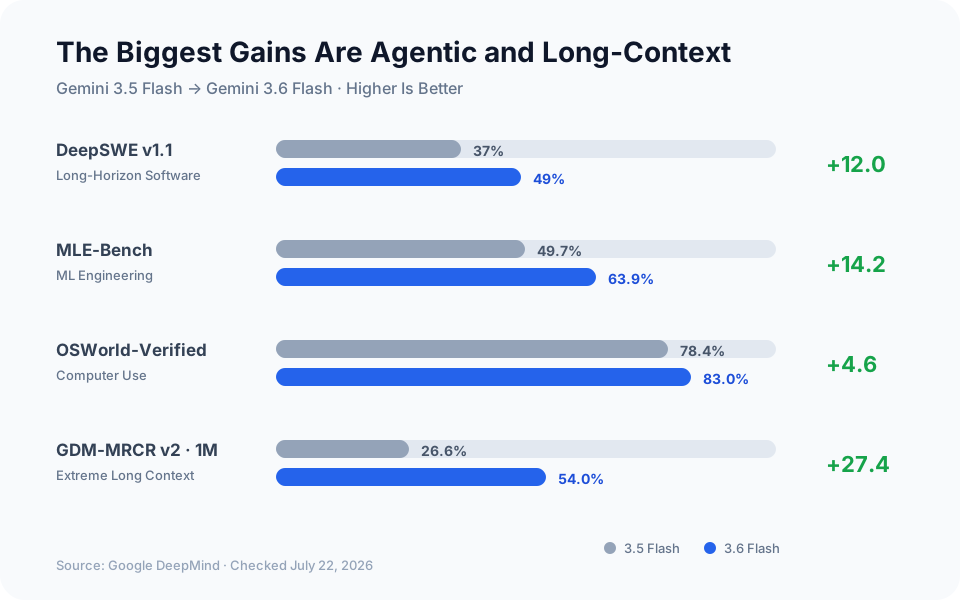
DeepSWE v1.1 rises from 37% for 3.5 Flash to 49%, while MLE-Bench rises from 49.7% to 63.9%. The largest improvements therefore appear in long-horizon software and machine-learning engineering rather than simple code completion.
2. Native Computer Use
Gemini 3.6 Flash supports native Computer Use, allowing an Agent to interpret interface screenshots and take actions. OSWorld-Verified improves from 78.4% to 83.0%.
Computer Use remains marked as Preview. Payments, file deletion, message sending, and permission changes still need human confirmation, allowlisted domains, audit logs, and least-privilege access. A benchmark result is not a safety guarantee.
3. Multimodal Document and Chart Understanding
The model can process text, images, PDFs, audio, and video in one request. Google customer examples use it for document parsing, chart and data analysis, report drafting, and evidence retrieval from financial material.
On the CharXiv chart-understanding benchmark, 3.6 Flash scores 85.2% without tools and 89.4% with tools, compared with 84.2% and 84.9% for 3.5 Flash. The tool-assisted gain suggests that it can combine visual understanding with external operations rather than merely transcribe a chart.
4. Much Better Long-Context Retrieval
The 1M-token limit is useful only if the model can retrieve relevant information. GDM-MRCR v2 reports:
- 128K: 91.8%, versus 77.3% for 3.5 Flash;
- 1M: 54.0%, versus 26.6% for 3.5 Flash.
Performance at the extreme context length nearly doubles, but 54% is also a warning against placing an entire knowledge base into one unfiltered prompt. Important workflows still need retrieval, chunking, citations, and result verification.
How Should You Read the Benchmarks?
Within the Flash family, Gemini 3.6 Flash improves on all major figures published by Google:
| Benchmark | Focus | Gemini 3.6 Flash | Gemini 3.5 Flash |
|---|---|---|---|
| SWE-Bench Pro Public | Diverse Agentic coding | 58.7% | 55.1% |
| DeepSWE v1.1 | Long-horizon software engineering | 49% | 37% |
| Terminal-Bench 2.1 | Agentic terminal coding | 78.0% | 76.2% |
| MLE-Bench | Machine-learning engineering | 63.9% | 49.7% |
| OSWorld-Verified | Computer Use | 83.0% | 78.4% |
| GDPVal-AA v2 | Knowledge work, Elo | 1421 | 1349 |
| CharXiv, with tools | Complex chart synthesis | 89.4% | 84.9% |
| GDM-MRCR v2, 128K | Long-context retrieval | 91.8% | 77.3% |
| GDM-MRCR v2, 1M | Extreme long-context retrieval | 54.0% | 26.6% |
A comparison with current July 2026 models gives a more complete picture. The same Google DeepMind table reports:
| Benchmark | Gemini 3.6 Flash | GPT-5.6 Luna | Grok 4.5 | Claude Sonnet 5 |
|---|---|---|---|---|
| SWE-Bench Pro Public | 58.7% | 62.7% | 64.7% | 63.2% |
| DeepSWE v1.1 | 49% | 67% | 54% | 54% |
| MLE-Bench | 63.9% | 47.6% | 43.2% | 66.9% |
| OSWorld-Verified | 83.0% | 72.6% | Not reported | 81.2% |
| GDPVal-AA v2 | 1421 | 1584 | 1535 | 1607 |
| CharXiv, no tools | 85.2% | 82.7% | 81.6% | 77.0% |
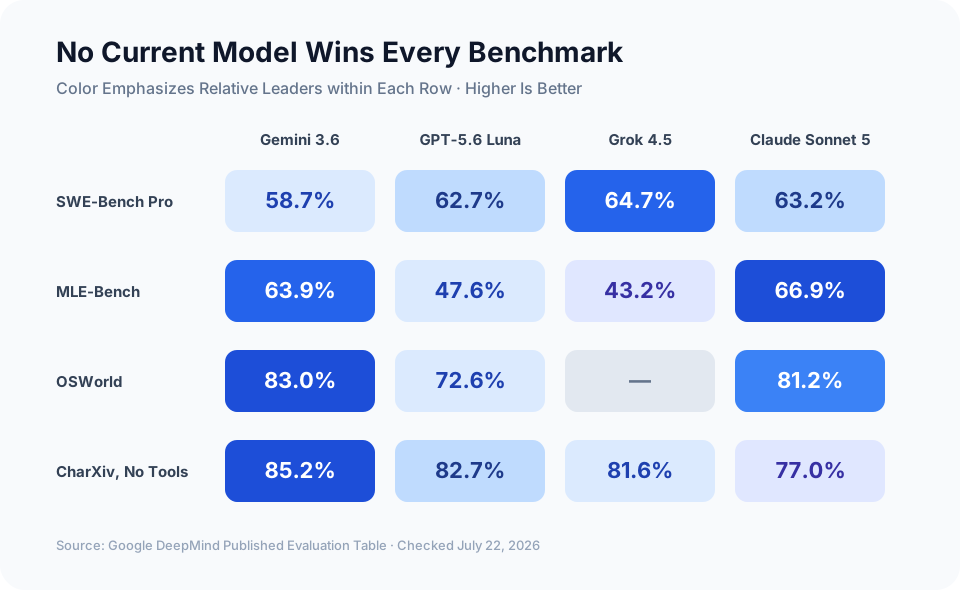
The model’s position is therefore specific rather than universal:
- it is highly competitive in Computer Use, chart understanding, and some machine-learning engineering tasks;
- it does not broadly outperform current frontier or upper-tier models in software engineering and knowledge work;
- its practical advantage emerges only when capability is considered alongside speed, price, and context length.
All figures above come from Google’s published evaluation table. Even with a methodology page, a vendor naturally selects evaluations that show its product’s value. Use public benchmarks to shortlist models, not to replace an acceptance test on real business tasks.
What Do Independent Tests and Early Users Say?
Gemini 3.6 Flash had been public for only one day when this article was checked. There is no mature consensus covering enough tasks, languages, and long-term reliability. The available evidence is best separated into independent measurements, selected customer cases, and open community discussion.
Artificial Analysis: Excellent Speed with Strong but Not Topmost Intelligence
As of July 22, 2026, Artificial Analysis reported for the high-reasoning configuration:
- Intelligence Index: 50, ranking 21st among 186 models in the page’s comparison class;
- output speed: approximately 275.5 tokens per second, ranking first in that class;
- input price: $1.50 per million tokens;
- output price: $7.50 per million tokens;
- weighted average cost per Intelligence Index task: approximately $0.50.
These rankings will change as models and provider data are updated. They nevertheless support the central interpretation: the strongest quality of 3.6 Flash is the balance among intelligence, response speed, and price, not the highest standalone capability score.
Selected Customer Cases: Positive Business Signals, Not an Independent Survey
Google DeepMind presents four early customer statements:
- Figma says the model balances quality, speed, and cost, enabling faster prototype exploration and iteration;
- Harvey reports strong internal benchmark gains and document-drafting and review tasks completed 12% faster on average;
- Hebbia says it was the best model the company tested for evidence finding in citation-heavy financial research;
- JetBrains Junie describes coding and reasoning quality close to Gemini Pro with the Flash speed and cost profile, and a 10–20% gain in low-reasoning coding performance.
These statements come from real product teams and are more useful than generic marketing copy. However, Google selected the examples, and the complete test sets and failure cases are not public. Treat them as a reason to run a trial, not as an independent customer-satisfaction study.
Hacker News: Praise for Speed, Questions about Relative Price and the Capability Ceiling
Around 16 hours after release, the Hacker News submission had roughly 671 points and 515 comments, showing substantial developer interest. Representative themes included:
- one developer described the Intelligence score as middle-to-upper range but highlighted intelligence per task time and output speed;
- a user called 3.5 Flash an underrated frontend-iteration model because it was fast and easy to retry, and expected 3.6 to continue that strength;
- other commenters questioned whether 3.6 Flash is competitively priced against GLM-5.2, DeepSeek V4 Flash, and other low-cost models rather than only against Google’s predecessor;
- some discussion argued that Google’s focus on Flash efficiency may leave the highest-capability tier behind GPT-5.6 or Claude Fable 5.
These are self-selected release-day comments, and many participants had not completed controlled tests. They are useful for identifying what to measure—frontend quality, real token usage, total task cost, and hard coding performance—not for declaring an overall positive or negative verdict.
Which Workloads Should Test It First?
Strong Candidates
- Real-time AI Agents: low latency, Function Calling, search, and multi-step tool use;
- coding assistants and frontend iteration: fast modifications, visual understanding, and rapid retry cycles;
- long documents and large repositories: substantial PDF, log, specification, or code input;
- chart and financial-material analysis: evidence extraction and explanations across visual and textual sources;
- browser and desktop automation: native Computer Use with human approval controls;
- high-concurrency online features: workloads where capability is sufficient and throughput matters.
Workloads That Should Not Switch without Testing
- tasks requiring the highest software-engineering or knowledge-work performance, with little concern for latency or cost;
- native image or audio generation, or real-time bidirectional audio through the Live API;
- high-risk legal, medical, or financial conclusions without human review;
- exhaustive fact retrieval near the maximum context length;
- systems that depend on
temperature, assistant prefill, or multiple response candidates.
What Must Change When Migrating from an Older Gemini Model?
Gemini 3.6 Flash is not a simple model-ID replacement. Google’s latest-model guide lists several compatibility changes:
temperature,top_p, andtop_kare deprecated and ignored, with future 400 errors planned;- prefer
thinking_levelwhen integrating directly against Google’s latest-model interface; the UnifyLLM Gemini-native compatibility endpoint can also passthinkingConfig.thinkingBudgetandincludeThoughts; - model or assistant response prefill is no longer supported;
candidate_countis not supported;- the default thinking level is
medium; - Google recommends evaluating the Interactions API for new projects.
Remove ineffective sampling parameters from the request body, then measure how the relevant thinking level or thinking budget affects accuracy, latency, and cost. Google-direct interfaces, SDK versions, and the UnifyLLM native compatibility endpoint may use different field shapes, so do not mix the two request formats.
For fixed output formats, prefer Structured Outputs or JSON Schema over lowering temperature. Agent evaluations should record tool calls, retries, output tokens, and end-to-end time to determine whether the model truly reduces cost per completed task.
Connect Gemini 3.6 Flash through UnifyLLM
UnifyLLM supports two ways to call Gemini: the Gemini-native generateContent format and the OpenAI-compatible format for switching among providers. Both use an UnifyLLM key, but the request paths and parameter structures differ.
Method One: Use the Gemini-Native Format with Thinking
The native format preserves Gemini structures such as contents, parts, generationConfig, and thinkingConfig. This example assigns a 1,024-token thinking budget and requests thought content with includeThoughts: true:
curl --location --request POST \
  'https://api.unifyllm.top/v1beta/models/gemini-3.6-flash:generateContent?key=<YOUR_UNIFYLLM_API_KEY>' \
  --header 'Content-Type: application/json' \
  --data-raw '{
    "contents": [
      {
        "parts": [
          {
            "text": "How many trees can a woodpecker peck?"
          }
        ]
      }
    ],
    "generationConfig": {
      "thinkingConfig": {
        "thinkingBudget": 1024,
        "includeThoughts": true
      }
    }
  }'
Use this route when an application already uses a Gemini SDK, needs precise access to Gemini-native capabilities, or needs thought content. thinkingBudget affects latency and billing, so size it to the task. Never place a real key in a public script, log, or repository. Because this format carries the key in the query string, sanitize gateway and access logs carefully.
Method Two: Use the OpenAI-Compatible Format to Switch Models
If you need to compare Gemini 3.6 Flash with GPT-5.6, Claude Sonnet 5, Grok 4.5, or other current models under the same conditions, the OpenAI-compatible interface reduces provider-specific client changes.
Use the following configuration:
Protocol: OpenAI Compatible
Base URL: https://api.unifyllm.top/v1
API key: a dedicated key created in the UnifyLLM console
Model: gemini-3.6-flash
A minimal OpenAI-compatible request looks like this:
curl https://api.unifyllm.top/v1/chat/completions \
  -H "Authorization: Bearer <YOUR_UNIFYLLM_API_KEY>" \
  -H "Content-Type: application/json" \
  -d '{
    "model": "gemini-3.6-flash",
    "messages": [
      {
        "role": "user",
        "content": "Compare the three implementation options in this product requirement. Return a table covering cost, risk, and dependencies."
      }
    ]
  }'
The second example intentionally omits temperature because Gemini 3.6 Flash deprecates that parameter. Prefer the first format when Gemini-native thinking controls matter; prefer the second when one client must switch among providers. Model availability for your account, current charges, and enabled capabilities are determined by the current UnifyLLM console model list.
Blind-test candidates on the same real tasks and record task pass rate, serious errors, format compliance, time to first token, total time, input and output tokens, tool calls, and actual charges. See Getting Started, Integrations, and the API Reference before connecting.
Conclusion
Gemini 3.6 Flash is a focused upgrade: lower output pricing, better coding, machine-learning engineering, Computer Use, chart understanding, and long-context retrieval, plus an effort to reduce verbosity, unrelated edits, and tool loops. Early Artificial Analysis data also confirms that it is exceptionally fast.
It is not first on every benchmark and should not be presented as a universal replacement for current frontier models. A more accurate description is: a capable, extremely fast, long-context workhorse optimized for production Agents.
For real-time Agents, code iteration, document analysis, and multimodal knowledge work, Gemini 3.6 Flash belongs on the first shortlist. For maximum-difficulty reasoning or coding, compare it under identical conditions with current models such as GPT-5.6, Claude Sonnet 5, Grok 4.5, GLM-5.2, and DeepSeek V4, then decide using task success rate, total cost, and latency.
Frequently Asked Questions
Is Gemini 3.6 Flash Generally Available?
Yes. Google marks gemini-3.6-flash as generally available through the Gemini API, Google AI Studio, Gemini App, Gemini Enterprise, Google Antigravity, and other channels. Rollout timing may vary by region, account, and product.
How Many Parameters Does Gemini 3.6 Flash Have?
Google has not disclosed the total or active parameter count or detailed MoE structure. Confirmed specifications include a 1,048,576-token input limit, a 65,536-token output limit, and a default medium thinking level. Community estimates are not official data.
How Much Cheaper Is Gemini 3.6 Flash than 3.5 Flash?
Input pricing is unchanged, while output pricing falls from $9.00 to $7.50 per million tokens, a 16.7% output-rate reduction. Real task savings depend on the input-output ratio, thinking tokens, caching, tool charges, retries, and actual generation length.
Can Gemini 3.6 Flash Generate Images or Speech?
The standard gemini-3.6-flash model can understand images, video, and audio, but its output modality is text. It does not generate images or audio and does not support the Live API. Use a specialized media or live-audio model for those tasks.
Does Temperature Still Work?
It should not be used. Google’s latest-model documentation says temperature, top_p, and top_k are deprecated and ignored, with future 400 errors planned. Use explicit instructions, Structured Outputs, and thinking_level instead.
Does a 1M Context Window Mean I Can Send an Entire Knowledge Base?
The model can technically accept extremely long input, but reliable recall is not guaranteed. Google’s 1M long-context benchmark is 54.0%, substantially better than the previous generation but still imperfect. Production systems should combine retrieval, chunking, citations, and verification.
References
- Google: Introducing Gemini 3.6 Flash, 3.5 Flash-Lite, and 3.5 Flash Cyber
- Google DeepMind: Gemini 3.6 Flash
- Gemini API: Gemini 3.6 Flash Model Specifications
- Gemini API: Latest Model and Migration Guide
- Gemini API Pricing
- Google DeepMind: Gemini 3.6 Flash Model Card
- Artificial Analysis: Gemini 3.6 Flash Performance & Price Analysis
- Hacker News: Gemini 3.6 Flash Release Discussion